
This website uses cookies to give you the best user experience. If you continue
without changing your settings we'll assume you are happy to receive all RSC cookies.
You can change your cookie settings by navigating to our Privacy and Cookies page and following the instructions. These instructions
are also obtainable from the privacy link at the bottom of any RSC page.
A journal linking all aspects of the chemical, physical and biotechnological sciences relating to energy conversion and storage, alternative fuel technologies and environmental science.
Low Carbon Mobility Centre, Smith School of Enterprise and the Environment, University of Oxford, Hayes House, 75 George Street, Oxford, UK
E-mail: xiaoyu.yan@alumni.qmul.net
; Tel: +44 (0)1865 614915
b
Department of Plant Sciences, University of Oxford, South Parks Road, Oxford, UK
E-mail: andrew.smith@plants.ox.ac.uk
; Fax: +44 (0)1865 275074
; Tel: +44 (0)1865 275009
c
Faculty of Agriculture Food and Natural Resources, The University of Sydney, Sydney, Australia
E-mail: daniel.tan@sydney.edu.au
; Fax: +61 2 8627 1099
; Tel: +61 2 8627 1052
Energy Environ. Sci., 2011,4, 3110-3121
DOI:
10.1039/C1EE01107C
Received
29 Jan 2011,
Accepted
24 Jun 2011
First published online
28 Jul 2011
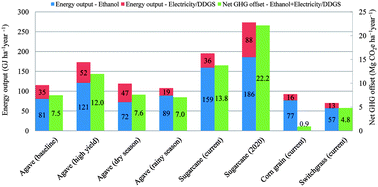
The sustainability of large-scale biofuel production has recently been called into question in view of mounting concerns over the associated impact on land and water resources. As the most predominant biofuel today, ethanol produced from food crops such as corn in the US has been frequently criticised. Ethanol derived from cellulosic feedstocks is likely to overcome some of these drawbacks, but the production technology is yet to be commercialised. Sugarcane ethanol is the most efficient option in the short term, but its success in Brazil is difficult to replicate elsewhere. Agaves are attracting attention as potential ethanol feedstocks because of their many favourable characteristics such as high productivities and sugar content and their ability to grow in naturally water-limited environments. Here, we present the first life cycle energy and greenhouse gas (GHG) analysis for agave-derived ethanol. The results suggest that ethanol derived from agave is likely to be superior, or at least comparable, to that from corn, switchgrass and sugarcane in terms of energy and GHG balances, as well as in ethanol output and net GHG offset per unit land area. Our analysis highlights the promising opportunities for bioenergy production from agaves in arid or semi-arid regions with minimum pressure on food production and water resources.
Fetching data from CrossRef. This may take some time to load.
This may take some time to load.
Energy & Environmental Science
- Information Point