This website uses cookies to give you the best user experience. If you continue
without changing your settings we'll assume you are happy to receive all RSC cookies.
You can change your cookie settings by navigating to our Privacy and Cookies page and following the instructions. These instructions
are also obtainable from the privacy link at the bottom of any RSC page.
Department of Inorganic and Physical Chemistry, Indian Institute of Science, Bangalore, India
E-mail: arc@ipc.iisc.ernet.in
; Fax: 91-80-23600683
; Tel: 91-80-22932533
b
Department of Biochemistry, Indian Institute of Science, Bangalore, India
E-mail: anjali@biochem.iisc.ernet.in
; Tel: 91-80-22932306
Dalton Trans., 2011,40, 11904-11913
DOI:
10.1039/C1DT11102G
Received
12 Jun 2011,
Accepted
22 Aug 2011
First published online
05 Oct 2011
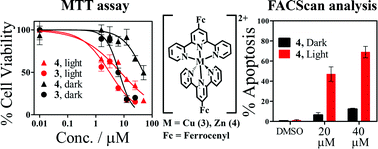
Ferrocenyl terpyridine 3d metal complexes and their analogues, viz. [M(Fc-tpy)2](ClO4)2 (1–4), [Zn(Ph-tpy)2](ClO4)2 (5) and [Zn(Fc-dpa)2]X2 (X = ClO4, 6; PF6, 6a), where M = Fe(II) in 1, Co(II) in 2, Cu(II) in 3 and Zn(II) in 4, Fc-tpy is 4′-ferrocenyl-2,2′:6′,2′′-terpyridine, Ph-tpy is 4′-phenyl-2,2′:6′,2′′-terpyridine and Fc-dpa is ferrocenyl-N,N-dipicolylmethanamine, are prepared and their DNA binding and photocleavage activity in visible light studied. Complexes 2, 4, 5 and 6a that are structurally characterized by X-ray crystallography show distorted octahedral geometry with the terpyridyl ligands binding to the metal in a meridional fashion, with Fc-dpa in 6a showing a facial binding mode. The Fc-tpy complexes display a charge transfer band in the visible region. The ferrocenyl (Fc) complexes show a quasi-reversible Fc+-Fcredox couple within 0.48 to 0.66 V vs.SCE in DMF-0.1 M TBAP. The DNA binding constants of the complexes are 104 M−1. Thermal denaturation and viscometric data suggest DNA surface binding through electrostatic interaction by the positively charged complexes. Barring the Cu(II) complex 3, the complexes do not show any chemical nuclease activity in the presence of glutathione. Complexes 1–4 exhibit significant plasmidDNA photocleavage activity in visible light via a photoredox pathway. Complex 5, without the Fc moiety, does not show any DNA photocleavage activity. The Zn(II) complex 4 shows a significant PDT effect in HeLa cancer cells giving an IC50 value of 7.5 μM in visible light, while being less toxic in the dark (IC50 = 49 μM).
Fetching data from CrossRef. This may take some time to load.