This website uses cookies to give you the best user experience. If you continue
without changing your settings we'll assume you are happy to receive all RSC cookies.
You can change your cookie settings by navigating to our Privacy and Cookies page and following the instructions. These instructions
are also obtainable from the privacy link at the bottom of any RSC page.
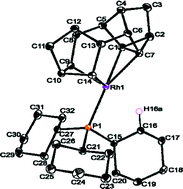
Transition-metal complexes containing (C–C)→M σ-interactions have potential applications in both catalysis and the activation and cleavage of C–C bonds. Fully characterising the bonding and interactions in complexes containing such (C–C)→M σ-interactions is vital to understand their chemical behaviour. As a result a high-resolution experimental X-ray charge density study has been undertaken on [Rh(Binor-S)(PCy3)][HCB11Me11] (Binor-S = 1,2,4,5,6,8-dimetheno-s-indacene) which contains a (C–C)→Rh interaction. The data are analysed using Bader's “Atoms in Molecules” (AIM) approach with particular attention paid to the interactions around the rhodium centre. The results provide clear evidence for the σ(C–C)→Rh interaction in the solid-state which is classified as a weak covalent interaction. These results are supported by theoretical calculations.
Fetching data from CrossRef. This may take some time to load.