This website uses cookies to give you the best user experience. If you continue
without changing your settings we'll assume you are happy to receive all RSC cookies.
You can change your cookie settings by navigating to our Privacy and Cookies page and following the instructions. These instructions
are also obtainable from the privacy link at the bottom of any RSC page.
University of Georgia, Department of Infectious Diseases and Nanoscale Science and Engineering Center, Athens, USA
E-mail: jdriskel@uga.edu
; Fax: +1 706-583-0176
; Tel: +1 706-542-2205
Analyst, 2011,136, 3083-3090
DOI:
10.1039/C1AN15303J
Received
12 Apr 2011,
Accepted
28 May 2011
First published online
13 Jun 2011
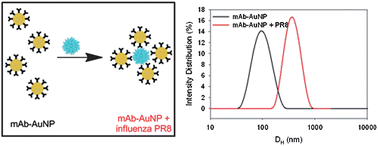
Herein we detail the development of a simple, rapid, and sensitive method for quantitative detection of influenza A virus using dynamic light scattering (DLS) and gold nanoparticle (AuNP) labels. Influenza-specific antibodies are conjugated to AuNPs, and aggregation of the AuNP probes is induced upon addition of the target virus. DLS is used to measure the extent of aggregation and the mean hydrodynamic diameter is correlated to virus concentration. The effects of nanoparticle concentration and size on the analytical performance of the assay were systematically investigated. It was determined that decreasing the AuNP probe concentration improves the detection limit while the effect of changing the AuNP size is minimal. Optimization of the assay provided a detection limit of <100 TCID50/mL which is 1–2 orders of magnitude improved over commercial diagnostic kits without increasing the assay time or complexity. Additionally, this assay was demonstrated to perform equivalently for influenza virus prepared in different biological matrices.
Fetching data from CrossRef. This may take some time to load.