This website uses cookies to give you the best user experience. If you continue
without changing your settings we'll assume you are happy to receive all RSC cookies.
You can change your cookie settings by navigating to our Privacy and Cookies page and following the instructions. These instructions
are also obtainable from the privacy link at the bottom of any RSC page.
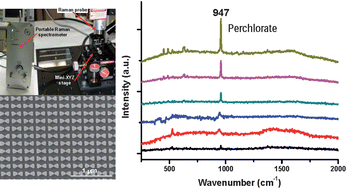
An integrated field-portable surface enhanced Raman scattering (SERS) sensing system has been developed and evaluated for quantitative analysis of energetics such as perchlorate (ClO4−) and trinitrotoluene (TNT) at environmentally relevant concentrations and conditions. The detection system consists of a portable Raman spectrometer equipped with an optical fiber probe that is coupled with novel elevated gold bowtie nanostructural arrays as a sensitive and reproducible SERS substrate. Using the standard addition technique, we show that ClO4− and TNT can be quantified at concentrations as low as 0.66 mg L−1 (or 6.6 µM) and 0.20 mg L−1 (0.9 µM), respectively, in groundwater samples collected from selected military sites. This research represents the first step toward the development of a field SERS sensor which may permit rapid, in situ screening and analysis for various applications including national security, chemical, biological and environmental detection.
An integrated field-portable surface enhanced Raman scattering (SERS) sensing system has been developed and evaluated for quantitative analysis of energetics such as perchlorate (ClO4–) and trinitrotoluene (TNT) at environmentally relevant concentrations and conditions. The detection system consists of a portable Raman spectrometer equipped with an optical fiber probe that is coupled with novel elevated gold bowtie nanostructural arrays as a sensitive and reproducible SERS substrate. Using the standard addition technique, we show that ClO4– and TNT can be quantified at concentrations as low as 0.66 mg L–1 (or 6.6 µM) and 0.20 mg L–1 (0.9 µM), respectively, in groundwater samples collected from selected military sites. This research represents the first step toward the development of a field SERS sensor which may permit rapid, in situ screening and analysis for various applications including national security, chemical, biological and environmental detection.
Fetching data from CrossRef. This may take some time to load.