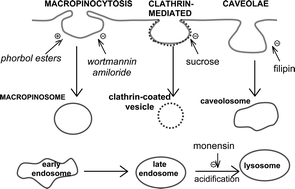
A series of experiments has been undertaken in order to gain a greater understanding of the cellular uptake and localisation behaviour of emissive lanthanide complexes as cellular stains or probes. Out of a large number of structurally related complexes characterised recently, a set of seven representative examples has been examined in detail, containing either tetraazatriphenylene or azaxanthone-based sensitising chromophores. Intracellular localisation profiles and cellular uptake and egress behaviour have been studied by microscopy and flow cytometry. Typically, the maximum intracellular concentration was of the order of 0.4 mM, or about 109 complexes per cell. The complexes studied were generally not toxic and did not perturb the mitochondrial membrane potential. A common uptake mechanism of macropinocytosis has been identified. A generalisation of trends in behaviour, and structure–activity relationships is presented, and the implications for future probe design discussed.
You have access to this article
 Please wait while we load your content...
Something went wrong. Try again?
Please wait while we load your content...
Something went wrong. Try again?