This website uses cookies to give you the best user experience. If you continue
without changing your settings we'll assume you are happy to receive all RSC cookies.
You can change your cookie settings by navigating to our Privacy and Cookies page and following the instructions. These instructions
are also obtainable from the privacy link at the bottom of any RSC page.
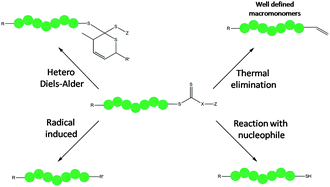
This paper describes both well-established routes and recent advances in the end group modification of polymers synthesised by reversible addition–fragmentation chain transfer (RAFT) polymerisation. The lability of the thiocarbonylthio group, which facilitates the RAFT mechanism, allows for ready post-polymerisation functionalisation of RAFT polymers by a number of techniques. In particular, end groupthermolysis, radical induced reduction, hetero-Diels–Alder reactions and reaction with nucleophiles are discussed as are the applications and limitations of each method. The versatility of RAFT as a polymerisation tool for the synthesis of polymers with functional end groups for a range of applications is demonstrated.
Fetching data from CrossRef. This may take some time to load.