This website uses cookies to give you the best user experience. If you continue
without changing your settings we'll assume you are happy to receive all RSC cookies.
You can change your cookie settings by navigating to our Privacy and Cookies page and following the instructions. These instructions
are also obtainable from the privacy link at the bottom of any RSC page.
Photo-responsive systems and biomaterials: photochromic polymers, light-triggered self-assembly, surface modification, fluorescence modulation and beyond
Centre for Advanced Macromolecular Design, School of Chemical Sciences and Engineering, The University of New South Wales, Sydney, Australia
E-mail: Richard.Evans@csiro.au
b
CSIRO Molecular & Health Technologies, Bag 10, Clayton, Australia
c
The Cooperative Research Centre for Polymers, 8 Redwood Drive, Notting Hill, Australia
Polym. Chem., 2010,1, 37-54
DOI:
10.1039/B9PY00300B
Received
15 Oct 2009,
Accepted
03 Nov 2009
First published online
25 Nov 2009
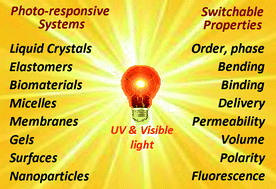
There has been considerable interest in the application of photochromism to photo-responsive systems which has led to the development of new tailored smart materials for photonics and biomedical fields. Within a polymeric matrix photochromic isomerizations can be stimulated by light to reversibly alter the physical and chemical properties of a material such as LC phase, shape, surface wettability, permeability, solubility, self-assembly, size and fluorescence. The underlying principles behind photo-responsive behavior, subsequent applications and relevant examples are discussed in this review.
Fetching data from CrossRef. This may take some time to load.