This website uses cookies to give you the best user experience. If you continue
without changing your settings we'll assume you are happy to receive all RSC cookies.
You can change your cookie settings by navigating to our Privacy and Cookies page and following the instructions. These instructions
are also obtainable from the privacy link at the bottom of any RSC page.
Toward one step analysis of cellular lipidomes using liquid chromatography coupled with mass spectrometry: application to Saccharomyces cerevisiae and Schizosaccharomyces pombe lipidomics
Yong Loo Lin School of Medicine, National University of Singapore, Department of Biochemistry, 8 Medical Drive, Singapore
E-mail: bchsgh@nus.edu.sg
; Fax: +65 (6777) 3271
; Tel: +65 (6516) 6684
b
Life Science Institute, 8 Medical Drive, Singapore
c
School of Biotechnology and Biomolecular Sciences, University of New South Wales, Sydney, 2052 New South Wales, Australia
d
Department of Biological Sciences, 8 Medical Drive, Singapore
Mol. BioSyst., 2010,6, 1008-1017
DOI:
10.1039/B913353D
Received
06 Jul 2009,
Accepted
14 Jan 2010
First published online
25 Feb 2010
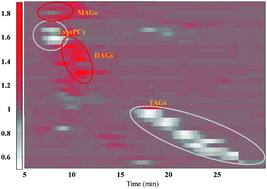
Recent rapid growth of lipidomics is mainly attributed to technological advances in mass spectrometry. Development of soft ionization techniques, in combination with computational tools, has spurred subsequent development of various methods for lipid analysis. However, none of these existing approaches can cover major cellular lipids in a single run. Here we demonstrate that a single method of liquid chromatography coupled with mass spectrometry (LCMS) can be used for simultaneous profiling of major cellular lipids including glycerophospholipids (PLs), sphingolipids (SPLs), waxes, sterols (ST) and mono-, di- as well as triacylglycerides (MAG, DAG, TAG). We applied this approach to analyze these lipids in various organisms including Saccharomyces cerevisiae and Schizosaccharomyces pombe. While phospholipids and triacylglycerides of S. pombe mainly contain 18:1 fatty acyls, those of S. cerevisiae contain 16:1, 16:0 and 18:1 fatty acyls. S. cerevisiae and S. pombe contain distinct sphingolipid profiles. S. cerevisiae has abundant inositol phytoceramides (IPC), while S. pombe contains high levels of free phytoceramides as well as short chain phytoceramides (t18:1/20:0-B) and IPC (t18:1/20:0-B). In S. cerevisiae, our results demonstrated accumulation of ergosterol esters in tgl1Δ cells and accumulation of various TAG species in tgl3Δ cells, which are consistent with the function of the respective enzymes. Furthermore, we, for the first time, systematically characterized lipids in S. pombe and measured their dynamic changes in Δplh1Δdga1 cells at different growth phases. We further discussed dynamic changes of phospholipids, sphingolipids and neutral lipids in the progress of programmed cell death in Δplh1Δdga1 cells of S. pombe.
Recent rapid growth of lipidomics is mainly attributed to technological advances in mass spectrometry. Development of soft ionization techniques, in combination with computational tools, has spurred subsequent development of various methods for lipid analysis. However, none of these existing approaches can cover major cellular lipids in a single run. Here we demonstrate that a single method of liquid chromatography coupled with mass spectrometry (LCMS) can be used for simultaneous profiling of major cellular lipids including glycerophospholipids (PLs), sphingolipids (SPLs), waxes, sterols (ST) and mono-, di- as well as triacylglycerides (MAG, DAG, TAG). We applied this approach to analyze these lipids in various organisms including Saccharomyces cerevisiae and Schizosaccharomyces pombe. While phospholipids and triacylglycerides of S. pombe mainly contain 18 : 1 fatty acyls, those of S. cerevisiae contain 16 : 1, 16 : 0 and 18 : 1 fatty acyls. S. cerevisiae and S. pombe contain distinct sphingolipid profiles. S. cerevisiae has abundant inositol phytoceramides (IPC), while S. pombe contains high levels of free phytoceramides as well as short chain phytoceramides (t18:1/20 : 0-B) and IPC (t18:1/20 : 0-B). In S. cerevisiae, our results demonstrated accumulation of ergosterol esters in tgl1Δ cells and accumulation of various TAG species in tgl3Δ cells, which are consistent with the function of the respective enzymes. Furthermore, we, for the first time, systematically characterized lipids in S. pombe and measured their dynamic changes in Δplh1Δdga1 cells at different growth phases. We further discussed dynamic changes of phospholipids, sphingolipids and neutral lipids in the progress of programmed cell death in Δplh1Δdga1 cells of S. pombe.
Fetching data from CrossRef. This may take some time to load.