This website uses cookies to give you the best user experience. If you continue
without changing your settings we'll assume you are happy to receive all RSC cookies.
You can change your cookie settings by navigating to our Privacy and Cookies page and following the instructions. These instructions
are also obtainable from the privacy link at the bottom of any RSC page.
NIH Chemical Genomics Center, National Human Genome Research Institute, National Institutes of Health, Bethesda, USA
E-mail: asimeono@mail.nih.gov
; Fax: +1 301-217-5736
; Tel: +1 301-217-5721
b
Department of Chemistry & Biochemistry, University of California, San Diego 9500 Gilman Drive, La Jolla, USA
E-mail: mburkart@ucsd.edu
; Tel: +1 858-534-5673
Mol. BioSyst., 2010,6, 365-375
DOI:
10.1039/B913291K
Received
06 Jul 2009,
Accepted
11 Aug 2009
First published online
13 Oct 2009
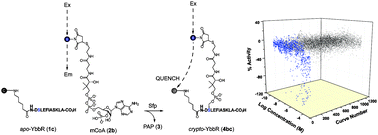
Surfactin-type phosphopantetheinyltransferases (Sfp-PPTases) are responsible for modifying type I polyketide and non-ribosomal peptide synthases of prokaryotes and have been implicated in the activation of a variety of pathogen-associated virulence factors. As such, inhibitors of this enzyme class represent enticing leads for antibiotic development and can serve as tools in studies of bacterial metabolism. Currently, no small molecule inhibitors of Sfp-PPTase are known, highlighting the need for efficient methods for PPTaseinhibitor identification and development. Herein, we present the design and implementation of a robust and miniaturized high-throughput kinetic assay for inhibitors of Sfp-PPTase using the substrate combination of rhodamine-labeled coenzyme A and Black Hole Quencher-2 labeled consensus acceptor peptide YbbR. Upon PPTase-catalyzed transfer of the rhodamine-labeled phosphopantetheinyl arm onto the acceptor peptide, the fluorescent donor and quencher are covalently joined and the fluorescence signal is reduced. This assay was miniaturized to a low 4 μL volume in 1536-well format and was used to screen the library of pharmacologically active compounds (LOPAC1280). Top inhibitors identified by the screen were further characterized in secondary assays, including protein phosphopantetheinylation detected by gel electrophoresis. The present assay enables the screening of large compound libraries against Sfp-PPTase in a robust and automated fashion and is applicable to designing assays for related transferase enzymes.
Fetching data from CrossRef. This may take some time to load.