This website uses cookies to give you the best user experience. If you continue
without changing your settings we'll assume you are happy to receive all RSC cookies.
You can change your cookie settings by navigating to our Privacy and Cookies page and following the instructions. These instructions
are also obtainable from the privacy link at the bottom of any RSC page.
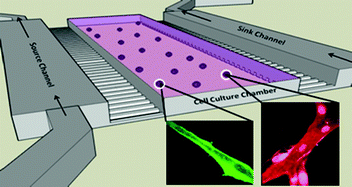
Endothelial cell (EC) sprouting morphogenesis is a critical step during angiogenesis, the formation of new blood vessels from existing conduits. Here, three-dimensional sprouting morphogenesis was examined using in vitro microfluidic devices that enabled the separate and simultaneous tuning of biomechanical and soluble biochemical stimuli. Quantitative analysis of endothelial sprout formation demonstrated that the ability of vascular endothelial growth factor (VEGF) to regulate stable sprout formation was mediated by the density of the surrounding collagen/fibronectin matrix. The coordinated migration and proliferation of multiple ECs to form stable sprouts were enhanced at intermediate matrix densities (1.2–1.9 mg ml−1), while lower densities resulted in uncoordinated migration (0.3–0.7 mg ml−1) and higher densities resulted in broad cellclusters that did not elongate (2.7 mg ml−1). Within the permissive range of matrix biomechanics, higher density matrices resulted in shorter, thicker, and slower-growing sprouts. The sprouts in higher density matrices also were more likely to polarize towards higher VEGF concentrations, included more cells per cross-sectional area, and demonstrated more stable lumen formation compared to sprouts in lower density matrices. These results quantitatively demonstrate that matrix density mediates VEGF-induced sprout polarization and lumen formation, potentially by regulating the balance between EC migration rate and proliferation rate.
Fetching data from CrossRef. This may take some time to load.