This website uses cookies to give you the best user experience. If you continue
without changing your settings we'll assume you are happy to receive all RSC cookies.
You can change your cookie settings by navigating to our Privacy and Cookies page and following the instructions. These instructions
are also obtainable from the privacy link at the bottom of any RSC page.
The Food and Environment Research Agency (Fera), Sand Hutton, York, UK
E-mail: don.clarke@fera.gsi.gov.uk
; Fax: +044-1904-462133
; Tel: +044-1904-462000
Anal. Methods, 2010,2, 310-325
DOI:
10.1039/B9AY00280D
Received
01 Dec 2009,
Accepted
18 Jan 2010
First published online
22 Feb 2010
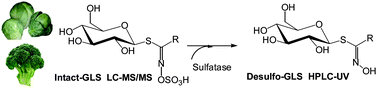
Glucosinolates (GLS) are sulfur rich, anionic secondary metabolites found principally in the plant order Brassicales. This review focuses on identifying the range of GLS structures identified to date and summarises the current state of taxonomic reclassifications of GLS producing plants. Those Brassica species that are available to growers in the UK are highlighted and progress in the aspects of analytical chemistry relevant to conducting accurate determinations of GLS content of foods is reviewed. The degradation and derivatisation workflows that have been utilized for conducting “glucosinolate analysis” are summarized. A review is made of aspects of extraction, isolation, determination of purity, ultraviolet (UV) and mass spectrometry (MS) parameters, extinction coefficients, UV response factors, quantification procedures, and the availability of stable isotope labeled internal standards, and certified reference materials. An electronic database of structures, formulae and accurate masses of both the 200 known, and a further 180 predicted GLS, is provided for use in mass spectrometry.
Glucosinolates (GLS) are sulfur rich, anionic secondary metabolites found principally in the plant order Brassicales. This review focuses on identifying the range of GLS structures identified to date and summarises the current state of taxonomic reclassifications of GLS producing plants. Those Brassica species that are available to growers in the UK are highlighted and progress in the aspects of analytical chemistry relevant to conducting accurate determinations of GLS content of foods is reviewed. The degradation and derivatisation workflows that have been utilized for conducting “glucosinolate analysis” are summarized. A review is made of aspects of extraction, isolation, determination of purity, ultraviolet (UV) and mass spectrometry (MS) parameters, extinction coefficients, UV response factors, quantification procedures, and the availability of stable isotope labeled internal standards, and certified reference materials. An electronic database of structures, formulae and accurate masses of both the 200 known, and a further 180 predicted GLS, is provided for use in mass spectrometry. (138 references).
Fetching data from CrossRef. This may take some time to load.