This website uses cookies to give you the best user experience. If you continue
without changing your settings we'll assume you are happy to receive all RSC cookies.
You can change your cookie settings by navigating to our Privacy and Cookies page and following the instructions. These instructions
are also obtainable from the privacy link at the bottom of any RSC page.
Department of Chemistry and Biomolecular Science, Clarkson University, Potsdam, USA
E-mail: ekatz@clarkson.edu
; Fax: +1 (315) 268 6610
; Tel: +1 (315) 268 4421
b
Department of NanoEngineering, University of California—San Diego, La Jolla, USA
E-mail: josephwang@ucsd.edu
; Fax: +1 (858) 534 9553
; Tel: +1 (858) 246 0128
Analyst, 2010,135, 2249-2259
DOI:
10.1039/C0AN00270D
Received
27 Apr 2010,
Accepted
15 Jun 2010
First published online
09 Jul 2010
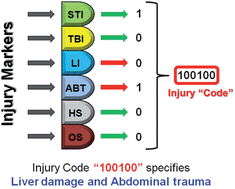
The development of a highly parallel enzyme logic sensing concept employing a novel encoding scheme for the determination of multiple pathophysiological conditions is reported. The new concept multiplexes a contingent of enzyme-based logic gates to yield a distinct ‘injury code’ corresponding to a unique pathophysiological state as prescribed by a truth table. The new concept is illustrated using an array of NAND and AND gates to assess the biomedical significance of numerous biomarker inputs including creatine kinase, lactate dehydrogenase, norepinephrine, glutamate, alanine transaminase, lactate, glucose, glutathione disulfide, and glutathione reductase to assess soft-tissue injury, traumatic brain injury, liver injury, abdominal trauma, hemorrhagic shock, and oxidative stress. Under the optimal conditions, physiological and pathological levels of these biomarkers were detected through either optical or electrochemical techniques by monitoring the level of the outputs generated by each of the six logic gates. By establishing a pathologically meaningful threshold for each logic gate, the absorbance and amperometric assays tendered the diagnosis in a digitally encoded 6-bit word, defined as an ‘injury code’. This binary ‘injury code’ enabled the effective discrimination of 64 unique pathological conditions to offer a comprehensive high-fidelity diagnosis of multiple injury conditions. Such processing of relevant biomarker inputs and the subsequent multiplexing of the logic gate outputs to yield a comprehensive ‘injury code’ offer significant potential for the rapid and reliable assessment of varied and complex forms of injury in circumstances where access to a clinical laboratory is not viable. While the new concept of parallel and multiplexed enzyme logic gates is illustrated here in connection to multi-injury diagnosis, it could be readily extended to a wide range of practical medical, industrial, security and environmental applications.
Fetching data from CrossRef. This may take some time to load.