


 SCHEDULED MAINTENANCE


The electrostatic origin of chiral patterns on nanofibers
Abstract
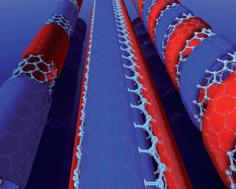
Several recent research works focus on nanofibers covered by molecules that self-assemble into chiral helices. While the formation of helical structures has been explained mostly on a case by case basis, the ubiquitous presence of chirality at the nanoscale suggests the existence of a unifying description. We present a model for computing the optimal arrangement of charged stripes over a cylindrical fiber, and show how helical structures can arise spontaneously from screened Coulomb interactions. We obtain the phase diagram and discuss some applications to nanoscale systems such as self-assembled
 Please wait while we load your content...


