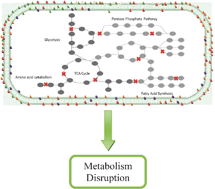
Tuberculosis continues to be a major health challenge, warranting the need for newer strategies for therapeutic intervention and newer approaches to discover them. Here, we report the identification of efficient metabolism disruption strategies by analysis of a reactome network. Protein–protein dependencies at a genome scale are derived from the curated metabolic network, from which insights into the nature and extent of inter-protein and inter-pathway dependencies have been obtained. A functional distance matrix and a subsequent nearness index derived from this information, helps in understanding how the influence of a given protein can pervade to the metabolic network. Thus, the nearness index can be viewed as a metabolic disruptability index, which suggests possible strategies for achieving maximal metabolic disruption by inhibition of the least number of proteins. A greedy approach has been used to identify the most influential singleton, and its combination with the other most pervasive proteins to obtain highly influential pairs, triplets and quadruplets. The effect of deletion of these combinations on cellular metabolism has been studied by flux balance analysis. An obvious outcome of this study is a rational identification of drug targets, to efficiently bring down mycobacterial metabolism.
You have access to this article
 Please wait while we load your content...
Something went wrong. Try again?
Please wait while we load your content...
Something went wrong. Try again?


 SCHEDULED MAINTENANCE


