This website uses cookies to give you the best user experience. If you continue
without changing your settings we'll assume you are happy to receive all RSC cookies.
You can change your cookie settings by navigating to our Privacy and Cookies page and following the instructions. These instructions
are also obtainable from the privacy link at the bottom of any RSC page.
School of Electronics and Computing Science, University of Southampton, Highfield, Southampton, UK
E-mail: dh2@ecs.soton.ac.uk
; Fax: +44(0)2380 593029
; Tel: +44(0)2380 596775
b
Division of Infection, Inflammation and Repair, School of Medicine, University of Southampton, Southampton
c
Philips Research Laboratories, 101 Cambridge Science Park, Milton Road, Cambridge, UK
Lab Chip, 2009,9, 2881-2889
DOI:
10.1039/B910053A
Received
21 May 2009,
Accepted
31 Jul 2009
First published online
07 Aug 2009
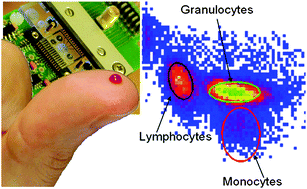
Miniature high speed label-free cell analysis systems have yet to be developed, but have the potential to deliver fast, inexpensive and simple full blood cell analysis systems that could be used routinely in clinical practice. We demonstrate a microfluidic single cell impedance cytometer that performs a white blood cell differential count. The device consists of a microfluidic chip with micro-electrodes that measure the impedance of single cells at two frequencies. Human blood, treated with saponin/formic acid to lyse erythrocytes, flows through the device and a complete blood count is performed in a few minutes. Verification of cell dielectric parameters was performed by simultaneously measuring fluorescence from CD antibody-conjugated cells. This enabled direct correlation of impedance signals from individual cells with phenotype. Tests with patient samples showed 95% correlation against commercial (optical/Coulter) blood analysis equipment, demonstrating the potential clinical utility of the impedance microcytometer for a point-of-care blood analysis system.
Fetching data from CrossRef. This may take some time to load.