This website uses cookies to give you the best user experience. If you continue
without changing your settings we'll assume you are happy to receive all RSC cookies.
You can change your cookie settings by navigating to our Privacy and Cookies page and following the instructions. These instructions
are also obtainable from the privacy link at the bottom of any RSC page.
This paper describes a microfluidic instrument that produces drops of supercooled water suspended in a moving stream of liquid fluorocarbon, and measures the temperatures at which ice nucleates in the drops. A microfluidic chip containing a monodisperse drop generator and a straight channel with 38 embedded resistance thermometers was placed in contact with a seven-zone temperature-control plate and imaged under a microscope with a high-speed camera. This instrument can record the freezing temperatures of tens of thousands of drops within minutes, with an accuracy of 0.4 °C. The ice-nucleation temperatures in 80-µm drops were reported for the freezing of 37061 drops of pure water, and of 8898 drops of water seeded with silver iodide. Nucleation of ice in pure water was homogenous and occurred at temperatures between −36 and −37.8 °C, while water containing silver iodide froze between −10 and −19 °C. The instrument recorded the largest sets of individual freezing temperatures (37061), had the fastest data acquisition rate (75 measurements/s), and the best optical (3 µm) and temporal (70 µs) resolutions among instruments designed to study nucleation of ice. The dendritic growth of ice in 150-µm drops of supercooled water at −35 °C was observed and imaged at a rate of 16000 frames/s.
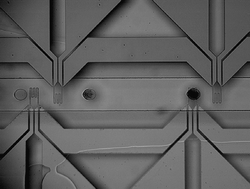
This paper describes a microfluidic instrument that produces drops of supercooled water suspended in a moving stream of liquid fluorocarbon, and measures the temperatures at which ice nucleates in the drops. A microfluidic chip containing a monodisperse drop generator and a straight channel with 38 embedded resistance thermometers was placed in contact with a seven-zone temperature-control plate and imaged under a microscope with a high-speed camera. This instrument can record the freezing temperatures of tens of thousands of drops within minutes, with an accuracy of 0.4 °C. The ice-nucleation temperatures in–80-µm drops were reported for the freezing of 37 061 drops of pure water, and of 8898 drops of water seeded with silver iodide. Nucleation of ice in pure water was homogenous and occurred at temperatures between –36 and –37.8 °C, while water containing silver iodide froze between –10 and –19 °C. The instrument recorded the largest sets of individual freezing temperatures (37 061), had the fastest data acquisition rate (75 measurements/s), and the best optical (3 µm) and temporal (70 µs) resolutions among instruments designed to study nucleation of ice. The dendritic growth of ice in 150-µm drops of supercooled water at –35 °C was observed and imaged at a rate of 16 000 frames/s.
Fetching data from CrossRef. This may take some time to load.