Potential of mid-infrared spectroscopy to aid the triage of patients with acute chest pain
W.
Petrich
,
K. B.
Lewandrowski
,
J. B.
Muhlestein
,
M. E. H.
Hammond
,
J. L.
Januzzi
,
E. L.
Lewandrowski
,
R. R.
Pearson
,
B.
Dolenko
,
J.
Früh
,
M.
Haass
,
M. M.
Hirschl
,
W.
Köhler
,
R.
Mischler
,
J.
Möcks
,
J.
Ordóñez–Llanos
,
O.
Quarder
,
R.
Somorjai
,
A.
Staib
,
C.
Sylvén
,
G.
Werner
and
R.
Zerback
Analyst, 2009, 134, 1092-1098
DOI:
10.1039/B820923E
Received
24 Nov 2008,
Accepted
23 Mar 2009
First published on the web
15 Apr 2009
This article is part of the collection:
Optical Diagnosis
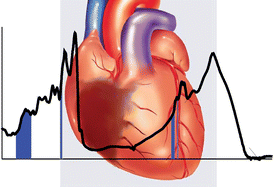
A total of 1,429 serum samples from 389 consecutive patients with acute chest pain were analyzed with the goal to aid the rapid diagnosis of acute myocardial infarction. To the best of our knowledge this is the largest and most comprehensive study on mid-infrared spectroscopy in cardiology. We were able to identify those signatures in the mid-infrared spectra of the samples, which were specific to either acute myocardial infarction or chest pain of other origin (angina pectoris, oesophagitis, etc). These characteristic spectral differences were used to distinguish between the cause of the donor's acute chest pain using robust linear discriminant analysis. A sensitivity of 88.5% and a specificity of 85.1% were achieved in a blind validation. The area under the receiver operating characteristics curve amounts to 0.921, which is comparable to the performance of routine cardiac laboratory markers within the same study population. The biochemical interpretation of the spectral signatures points towards an important role of carbohydrates and potentially glycation. Our studies indicate that the “Diagnostic Pattern Recognition (DPR)” method presented here has the potential to aid the diagnostic procedure as early as within the first 6 hours after the onset of chest pain.
Fetching data from CrossRef. This may take some time to load.