


 SCHEDULED MAINTENANCE

Discovery of three polymorphs of 7-fluoroisatin reveals challenges in using computational crystal structure prediction as a complement to experimental screening†‡
Abstract
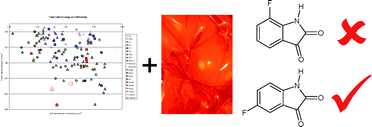
A combined computational and experimental polymorph search was undertaken to establish the crystal forms of ![[1 with combining macron]](https://www.rsc.org/images/entities/char_0031_0304.gif) , Z′ = 2), has an expanded four molecule R44(18) hydrogen bonding motif, which could not have been found within the routine computational study. The computed relative energies of the three forms are not in accord with experimental results. Thus, the experimental finding of three crystalline polymorphs of
, Z′ = 2), has an expanded four molecule R44(18) hydrogen bonding motif, which could not have been found within the routine computational study. The computed relative energies of the three forms are not in accord with experimental results. Thus, the experimental finding of three crystalline polymorphs of
- This article is part of the themed collection: Computational contributions to crystal engineering
 Please wait while we load your content...


