This website uses cookies to give you the best user experience. If you continue
without changing your settings we'll assume you are happy to receive all RSC cookies.
You can change your cookie settings by navigating to our Privacy and Cookies page and following the instructions. These instructions
are also obtainable from the privacy link at the bottom of any RSC page.
University of Maryland School of Medicine, Center for Fluorescence Spectroscopy, Department of Biochemistry and Molecular Biology, 725 W. Lombard St., Baltimore, USA
Analyst, 2008,133, 1308-1346
DOI:
10.1039/B802918K
First published online
16 Jul 2008
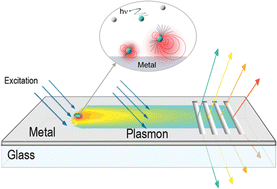
Fluorescence spectroscopy is widely used in biological research. Until recently, essentially all fluorescence experiments were performed using optical energy which has radiated to the far-field. By far-field we mean at least several wavelengths from the fluorophore, but propagating far-field radiation is usually detected at larger macroscopic distances from the sample. In recent years there has been a growing interest in the interactions of fluorophores with metallic surfaces or particles. Near-field interactions are those occurring within a wavelength distance of an excited fluorophore. The spectral properties of fluorophores can be dramatically altered by near-field interactions with the electron clouds present in metals. These interactions modify the emission in ways not seen in classical fluorescence experiments. In this review we provide an intuitive description of the complex physics of plasmons and near-field interactions. Additionally, we summarize the recent work on metal–fluorophore interactions and suggest how these effects will result in new classes of experimental procedures, novel probes, bioassays and devices.
Fluorescence spectroscopy is widely used in biological research. Until recently, essentially all fluorescence experiments were performed using optical energy which has radiated to the far-field. By far-field we mean at least several wavelengths from the fluorophore, but propagating far-field radiation is usually detected at larger macroscopic distances from the sample. In recent years there has been a growing interest in the interactions of fluorophores with metallic surfaces or particles. Near-field interactions are those occurring within a wavelength distance of an excited fluorophore. The spectral properties of fluorophores can be dramatically altered by near-field interactions with the electron clouds present in metals. These interactions modify the emission in ways not seen in classical fluorescence experiments. In this review we provide an intuitive description of the complex physics of plasmons and near-field interactions. Additionally, we summarize the recent work on metal-fluorophore interactions and suggest how these effects will result in new classes of experimental procedures, novel probes, bioassays and devices. (211 References).
Fetching data from CrossRef. This may take some time to load.