This website uses cookies to give you the best user experience. If you continue
without changing your settings we'll assume you are happy to receive all RSC cookies.
You can change your cookie settings by navigating to our Privacy and Cookies page and following the instructions. These instructions
are also obtainable from the privacy link at the bottom of any RSC page.
Supermolecules Group, National Institute for Materials Science (NIMS), 1-1 Namiki, Tsukuba, Japan
E-mail: ARIGA.Katsuhiko@nims.go.jp
; Fax: +81-29-860-4832
; Tel: +81-29-860-4597
Phys. Chem. Chem. Phys., 2007,9, 2319-2340
DOI:
10.1039/B700410A
Received
10 Jan 2007,
Accepted
07 Feb 2007
First published online
01 Mar 2007
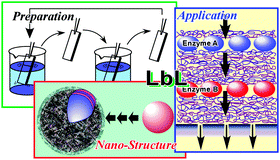
The layer-by-layer (LbL) adsorption technique offers an easy and inexpensive process for multilayer formation and allows a variety of materials to be incorporated within the film structures. Therefore, the LbL assembly method can be regarded as a versatile bottom-up nanofabrication technique. Research fields concerned with LbL assembly have developed rapidly but some important physicochemical aspects remain uninvestigated. In this review, we will introduce several examples from physicochemical investigations regarding the basics of this method to advanced research aimed at practical applications. These are selected mostly from recent reports and should stimulate many physical chemists and chemical physicists in the further development of LbL assembly. In order to further understand the mechanism of the LbL assembly process, theoretical work, including thermodynamics calculations, has been conducted. Additionally, the use of molecular dynamics simulation has been proposed. Recently, many kinds of physicochemical molecular interactions, including hydrogen bonding, charge transfer interactions, and stereo-complex formation, have been used. The combination of the LbL method with other fabrication techniques such as spin-coating, spraying, and photolithography has also been extensively researched. These improvements have enabled preparation of LbL films composed of various materials contained in well-designed nanostructures. The resulting structures can be used to investigate basic physicochemical phenomena where relative distances between interacting groups is of great importance. Similarly, LbL structures prepared by such advanced techniques are used widely for development of functional systems for physical applications from photovoltaic devices and field effect transistors to biochemical applications including nano-sized reactors and drug delivery systems.
Fetching data from CrossRef. This may take some time to load.
Physical Chemistry Chemical Physics
- Information Point