


 SCHEDULED MAINTENANCE

Survival of the fittest polymorph: how fast nucleater can lose to fast grower
Abstract
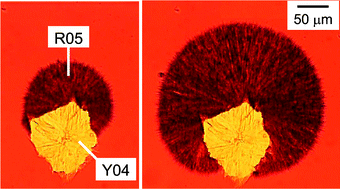
Controlling the crystallization of a liquid able to yield multiple polymorphs is often assumed to be a matter of controlling the initial nucleation. Recent studies found that this view is flawed because an early nucleating polymorph can nucleate another, faster-growing polymorph. We review how the phenomenon is controlled by thermodynamic and kinetic factors and how it can aid the discovery of new polymorphs. The selective
 Please wait while we load your content...


