This website uses cookies to give you the best user experience. If you continue
without changing your settings we'll assume you are happy to receive all RSC cookies.
You can change your cookie settings by navigating to our Privacy and Cookies page and following the instructions. These instructions
are also obtainable from the privacy link at the bottom of any RSC page.
Department of Zoology, University of Oxford, South Parks Road, Oxford, United Kingdom
E-mail: fritz.vollrath@zoology.oxford.ac.uk
; Fax: +44 (0) 1865 358221 Phone +44 (0) 1865 271216
Soft Matter, 2006,2, 377-385
DOI:
10.1039/B600098N
Received
04 Jan 2006,
Accepted
06 Mar 2006
First published online
29 Mar 2006
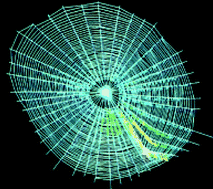
We present an overview of the physical properties of spider silks, and introduce a model designed to study the energy absorbed by the material as it stretches before breaking. Of particular interest are the inter- and intramolecular hydrogen bonds as well as the role of water in modifying the material properties of silk. A solid understanding of this interaction is of paramount importance for any deeper insights into the mechanical properties of any biomaterial. Here we note that the typical biological material has evolved to function in the fully hydrated i.e. elastomeric state. We conclude that silk after its transformation from the hydrated feedstock to the dehydrated fibre state can in fact be analysed in great detail and interpreted as representative of a wide range of elastomeric proteins covering, inter alia, bone, keratins, elastin and collagen.
Fetching data from CrossRef. This may take some time to load.