This website uses cookies to give you the best user experience. If you continue
without changing your settings we'll assume you are happy to receive all RSC cookies.
You can change your cookie settings by navigating to our Privacy and Cookies page and following the instructions. These instructions
are also obtainable from the privacy link at the bottom of any RSC page.
Evidence of near-field laser ablation inductively coupled plasma mass spectrometry (NF-LA-ICP-MS) at nanometre scale for elemental and isotopic analysis on gels and biological samples
Laser ablation inductively coupled plasma mass spectrometry (LA-ICP-MS) has been established as a powerful surface analytical method for local elemental analysis on metallic, ceramic, geological or biological sample surfaces. Here we show a new way of nanometre scale analysis of elements on sample surfaces by near-field LA-ICP-MS (NF-LA-ICP-MS). This technique uses the near-field enhancement effect on the tip of a thin silver needle in a laser beam (Nd:YAG laser, wavelength 532 nm) on the sample surface. The thin silver needle was etched electrolytically in an electrochemical cell using a droplet of citric acid as electrolyte. For nanolocal analysis by NF-LA-ICP-MS on soft matter (e.g., on 2-D gels and biological samples) a small volume transparent laser ablation chamber was constructed and coupled to a double-focusing sector field inductively coupled plasma mass spectrometer (ICP-MS). A small amount of soft sample material is ablated at atmospheric pressure by a single laser shot in the near-field of the silver tip in the defocused Nd:YAG laser beam. The ablated material is transported with argon as carrier gas into the inductively coupled plasma (ICP) ion source of the sensitive double-focusing sector field mass spectrometer with reverse Nier–Johnson geometry. By single-shot analysis on 2-D gels and biological surfaces doped with uranium in the μg g−1 range using NF-LA-ICP-MS an enhancement of ion intensities of transient signals in comparison with the background signal of up to factor 60 was observed. In gels doped with isotopically enriched 65Cu and 67Zn spikes by NF-LA-ICP-MS (single shot analysis) ion intensities up to the n
× 105 cps range and isotope ratios (235U/238U, 65Cu/63Cu and 67Zn/64Zn) were measured at a lateral resolution in the nanometre scale. Using the near-field effect in LA-ICP-MS, it was demonstrated that nanolocal analysis is possible in single-shot measurements of elements on biological samples and on a gel surface with spatial resolution at the hundreds of nanometres range. This first experiment on near-field LA-ICP-MS opens up a new, challenging path for future applications in nanoimaging of elements in life science, biology and medicine, e.g., for analyses of single cells, cell organelles or biological structures at nanometre range in order to detect neurodegenerative diseases, but also in material science, nanotechnologies and nanoelectronics.
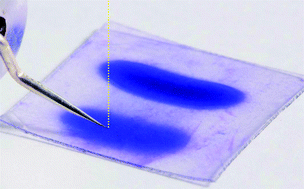
Laser ablation inductively coupled plasma mass spectrometry (LA-ICP-MS) has been established as a powerful surface analytical method for local elemental analysis on metallic, ceramic, geological or biological sample surfaces. Here we show a new way of nanometre scale analysis of elements on sample surfaces by near-field LA-ICP-MS (NF-LA-ICP-MS). This technique uses the near-field enhancement effect on the tip of a thin silver needle in a laser beam (Nd:YAG laser, wavelength 532 nm) on the sample surface. The thin silver needle was etched electrolytically in an electrochemical cell using a droplet of citric acid as electrolyte. For nanolocal analysis by NF-LA-ICP-MS on soft matter (e.g., on 2-D gels and biological samples) a small volume transparent laser ablation chamber was constructed and coupled to a double-focusing sector field inductively coupled plasma mass spectrometer (ICP-MS). A small amount of soft sample material is ablated at atmospheric pressure by a single laser shot in the near-field of the silver tip in the defocused Nd:YAG laser beam. The ablated material is transported with argon as carrier gas into the inductively coupled plasma (ICP) ion source of the sensitive double-focusing sector field mass spectrometer with reverse Nier-Johnson geometry. By single-shot analysis on 2-D gels and biological surfaces doped with uranium in the µg g–1 range using NF-LA-ICP-MS an enhancement of ion intensities of transient signals in comparison with the background signal of up to factor 60 was observed. In gels doped with isotopically enriched 65Cu and 67Zn spikes by NF-LA-ICP-MS (single shot analysis) ion intensities up to the n × 105 cps range and isotope ratios (235U/238U, 65Cu/63Cu and 67Zn/64Zn) were measured at a lateral resolution in the nanometre scale. Using the near-field effect in LA-ICP-MS, it was demonstrated that nanolocal analysis is possible in single-shot measurements of elements on biological samples and on a gel surface with spatial resolution at the hundreds of nanometres range. This first experiment on near-field LA-ICP-MS opens up a new, challenging path for future applications in nanoimaging of elements in life science, biology and medicine, e.g., for analyses of single cells, cell organelles or biological structures at nanometre range in order to detect neurodegenerative diseases, but also in material science, nanotechnologies and nanoelectronics.
Fetching data from CrossRef. This may take some time to load.
Journal of Analytical Atomic Spectrometry
- Information Point