


Cationic, linear Au(i) N-heterocyclic carbene complexes: synthesis, structure and anti-mitochondrial activity†
Abstract
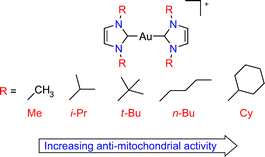
Six linear, two-coordinate cationic Au(I) N-heterocyclic carbene complexes of the form [(R2Im)2Au]+ (R = Me 1, Me, Et 2, i-Pr 3, n-Bu 4, t-Bu 5 and Cy 6) have been prepared by the reaction of two equivalents of the appropriate dialkylimidazol-2-ylidene (R2Im) with (Me2S)AuCl in dmf. Single crystal structural studies for 1·PF6, 2·PF6, 3·Cl and 4–6·PF6 show that for all six complexes the gold(I) centres have quasi-linear C–Au–C coordination, with quasi-parallel pairs of aromatic imidazole planes, except in 5·PF6 where they are quasi-normal; in the latter, Au–C are 2.038(3), 2.033(3) Å, cf. (e.g.) 3 2.027(2) Å. Inter-cation Au⋯Au are close at 3.487(2), 3.525(2) Å in 1·PF6 and 2·PF6. The structural studies and low temperature NMR experiments provide no supportive evidence for the presence of π back-bonding within this series of complexes. The lipophilicities of the six compounds, as estimated from the logarithm of the n-octanol–water partition coefficients (log P), varied across the series within the range −1.09 to 1.73. To investigate their potential as possible anti-mitochondrial anti-tumour agents, five of the compounds have been evaluated for their propensities to induce mitochondrial membrane permeabilization (MMP) in isolated rat liver mitochondria. At concentrations between 1–10 µM compounds 1·Br and 3–6·Cl induced dose-dependent, Ca2+-sensitive mitochondrial swelling at rates that increased with the lipophilicities of the complexes, with the most lipophilic compounds inducing the most rapid onset of swelling. The swelling was completely inhibited by cyclosporin A, the specific inhibitor of the mitochondrial permeability transition pore.
- This article is part of the themed collections: Celebrating 50 years of Dalton Transactions: Our Top 50 and RACI100: Celebrating Australian Chemistry
 Please wait while we load your content...


