This website uses cookies to give you the best user experience. If you continue
without changing your settings we'll assume you are happy to receive all RSC cookies.
You can change your cookie settings by navigating to our Privacy and Cookies page and following the instructions. These instructions
are also obtainable from the privacy link at the bottom of any RSC page.
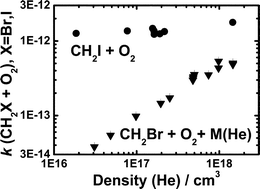
The kinetics of the reactions of CH2Br and CH2I radicals with O2 have been studied in direct measurements using a tubular flow reactor coupled to a photoionization mass spectrometer. The radicals have been homogeneously generated by pulsed laser photolysis of appropriate precursors at 193 or 248 nm. Decays of radical concentrations have been monitored in time-resolved measurements to obtain the reaction rate coefficients under pseudo-first-order conditions with the amount of O2 being in large excess over radical concentrations. No buffer gas density dependence was observed for the CH2I + O2 reaction in the range 0.2–15 × 1017 cm−3 of He at 298 K. In this same density range the CH2Br + O2 reaction was obtained to be in the third-body and fall-off area. Measured bimolecular rate coefficient of the CH2I + O2 reaction is found to depend on temperature as k(CH2I + O2)
=
(1.39 ± 0.01)
× 10−12
(T/300 K)−1.55 ± 0.06 cm3 s−1
(220–450 K). Obtained primary products of this reaction are I atom and IO radical and the yield of I-atom is significant. The rate coefficient and temperature dependence of the CH2Br + O2 reaction in the third-body region is k(CH2Br + O2
+ He)
=
(1.2 ± 0.2)
× 10−30
(T/300 K)−4.8 ± 0.3 cm6 s−1
(241–363 K), which was obtained by fitting the complete data set simultaneously to a Troe expression with the Fcent value of 0.4. Estimated overall uncertainties in the measured reaction rate coefficients are about ±25%.
Fetching data from CrossRef. This may take some time to load.
Physical Chemistry Chemical Physics
- Information Point