This website uses cookies to give you the best user experience. If you continue
without changing your settings we'll assume you are happy to receive all RSC cookies.
You can change your cookie settings by navigating to our Privacy and Cookies page and following the instructions. These instructions
are also obtainable from the privacy link at the bottom of any RSC page.
Department of Organic and Molecular Inorganic Chemistry, Stratingh Institute, University of Groningen, Nijenborgh 4, Groningen, The Netherlands
E-mail: J.H.van.Esch@rug.nl
b
BiOMaDe Technology Foundation, Nijenborgh 4, Groningen, The Netherlands
Org. Biomol. Chem., 2005,3, 1631-1639
DOI:
10.1039/B500837A
Received
19 Jan 2005,
Accepted
03 Mar 2005
First published online
21 Mar 2005
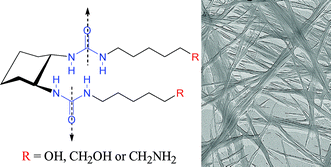
A new class of efficient hydrogelators has been developed by a simple modification of the peripheral substituents of cyclohexane bis-urea organogelators with hydrophilic hydroxy or amino functionalities. These bis-urea hydrogelators were synthesised in two or three steps using an alternative procedure to the common isocyanate method. Gelation was obtained with organic solvents, water and strongly basic aqueous solutions like 25% ammonia. Hydrogelation was found to depend on a delicate balance between the hydrophobicity of the alkyl chains, hydrophilicity of the terminal substituents and the enantiomeric purity of the compound. The hydrogels consisted of a network of fibers, in which all urea groups are involved in intermolecular hydrogen bonding. Most likely, gelation is driven by hydrophobic interactions of the methylene units, whereas hydrogen bond formation between the urea groups provides the necessary anisotropy of the aggregation and the high thermal stability of the gels.
Fetching data from CrossRef. This may take some time to load.
Organic & Biomolecular Chemistry
- Information Point